

Where all are Welcome
November 19, 2025
Centenary United Methodist Church creates a welcoming religious community for anyone who shows up at its door. The church’s rustic building with red bricks and wooden pews offers the perfect environment for worship.
The congregation is led by Reverend Sara Pugh Montgomery, who graciously upholds the church’s values of inclusion, social justice, and community engagement. Sunday services incorporate a mixture of music and prayers that underline a specific theme of the week, which is usually related to ideas of inclusivity, equity, and gratitude. Given Centenary’s strong values, community members are encouraged to find a sense of belonging within the church. The congregation is tight knit, and a typical service is bracketed by moments of conversation, laughter, and hugging. However, the church’s mission and values do not stop after the service concludes. Beyond worship, Centenary also focuses time and resources on outreach. Centenary distinguishes itself from other religious communities in the surrounding area through its “all are welcome” mentality that blends worship, service, and outreach.
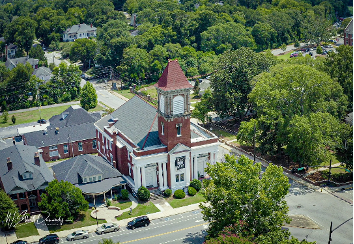
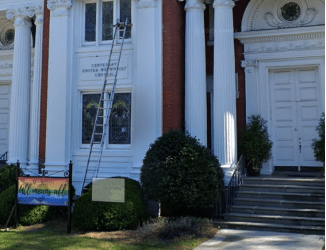
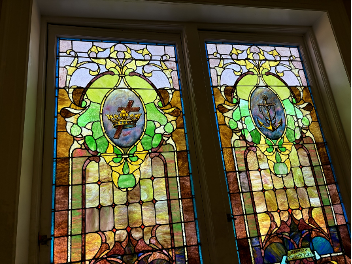
Centenary sits right on the edge of Mercer University’s campus and Tattnall Square Park. The church owns and uses multiple buildings for their offices, the fellowship hall, the sanctuary, and the Wesley house, a Mercer University organization associated with Centenary. Behind the office building sits a parking lot for church members to use during Sunday service, but many people parallel park out front and along Tattnall Square Park instead. A rainbow sign sits outside that reads “all means all. really.” allowing you to see a glimpse into their values before ever walking in. The sanctuary is an older building, utilizing red bricks and white columns and arches for the structure, with a tall bell tower in the center. A few stained glass windows line the outside of the building. They are decently sized, but sparsely spread.
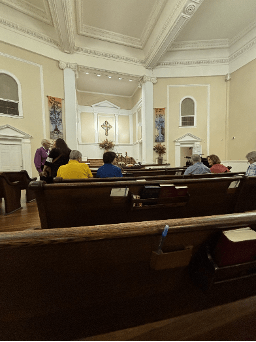
Inside, the building feels calm from the light yellow walls, highlighted by white trim and wooden flooring. A chandelier hangs in the middle of the room and four columns of pews with about six rows each, one in the center, two on either side of that, and a smaller section farthest left. At the front of the sanctuary, the church has dedicated an area for families through the use of a small table where children play. The program features a note to reserve that small left section for people with children. You can also sit upstairs, but we never saw up there as most people do not choose to do so.
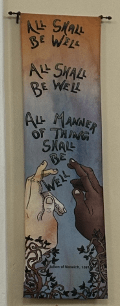
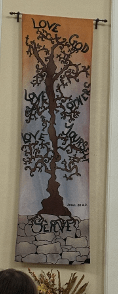
To the right, a piano sits where the music director plays and directs the songs sung throughout the service. In the center of the room up front, a podium resides on a small stage where Reverend Sara delivers her sermons. Few decorations adorn the walls, but on the right wall hangs a quilt with a visual of the four different seasons on it. On each side of the stage, banners hang with the world map on display. These banners were changed out sometime in October for different banners that had more of a Fall vibe to them. The one on the left of the stage was a tree with the words “love God, love others, love yourself” between the branches and “serve” under the roots. The one on the right got traded out for a picture of two hands reaching up to the words “all shall be well, all shall be well, all manner of thing shall be well.”
Centenary became who they are today after a period of rebirth. While it was established in 1884, the congregation slowly declined until around 2005 when there were only about 25-30 members left. Due to this, the senior pastor at the time asked the bishop, who serves as the head of many different churches in a certain geographic area, if he could experiment and try to see what this congregation was looking for. He was doing so in order to prevent Centenary from being shut down. The bishop agreed and then the pastor got to work. He asked the members a multitude of questions to help discern what they were looking for in both a congregation, and leadership. He asked the members if they would accept a woman or a Black pastor. The members responded with a resounding “yes.” From that time on, the congregation developed their core value of radical hospitality. They were willing to accept anyone into their church. With this core value at the forefront of his mind, the pastor worked to rebuild Centenary. Without this massive restructuring, the church would have been shut down and closed. Radical hospitality remains at the core of who Centenary is today, from their sign outside to their community outreach, Centenary strives to always welcome anyone.
Centenary is a predominantly older, white congregation, with some young adults and children present as well. Although few in number, there were some teens, and occasionally some Mercer students in attendance, adding a bit of generational diversity to the group. Although the church does not have an overly diverse population, members and leaders express openness to all sorts of backgrounds. For instance, Reverend Sara asked for volunteers from the more common service to attend the Spanish service and bridge congregations. Even though they do not speak the same language, her request demonstrates Centenary’s commitment to welcoming everyone.
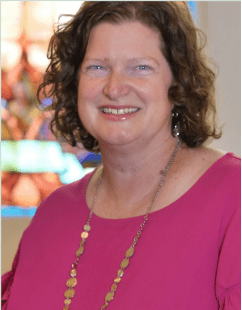
Although she is not the only person in a leadership position, Reverend Sara serves as the Senior pastor at Centenary and the only full time pastor. Originally from Virginia, she has been at Centenary for five years after serving as a pastor in Tulsa, Oklahoma for eight years. During Sunday services Reverend Sara has a more laid back demeanor and always has a smile on her face. She is extremely kind and makes a point to interact with the members both before and after service. We observed how appreciated she is by her congregation. Everyone who spoke about her had nothing to say other than kind words and praise for her leadership. One congregant even stated that Sara was the first person who she was able to actually learn from, fully taking in how she taught the Bible.
When delivering her sermon, Reverend Sara does not simply quote from the Bible to support her point, she uses personal anecdotes, metaphors, and even stories from others in order to convey the message, making it accessible for everyone to understand. She describes her leadership style as “shepherding.” She believes that through “guiding” her congregants, her message is much more effective than simply telling them what to do. She placed emphasis on the fact that even though she is a leader for the church, she does not want to be an authoritarian as she believes that she has as much to learn from her congregants as they do from her.
In observing the services, we noticed that each service follows the same structure as the previous. It always starts off with Reverend Sara introducing herself to everyone, followed by the announcements for the week. Centenary uses a lot of participatory elements within their services. Five to six songs are sung collectively by the congregation, with one of those being sung by the choir. The choir composition varies week by week, but typically includes twelve to fifteen individuals with a greater number of women. Another element that encourages engagement would be the call and responses incorporated in the service. Each one is written in the program with clear indication of what you are to listen to, and what you are to repeat, making it so everyone can follow along easily.
Reverend Sara also loves to ask questions to the congregation. She either tells them to turn to their neighbor and discuss, or encourages them to think about the questions when they leave. We also noticed that each week, a member of the congregation went onstage, told an anecdote, and then led a prayer. In our times of attending Centenary’s services, we never saw the same congregant lead the prayer twice. Children are also encouraged to participate in the service by helping the ushers pass around the offering basket for cash, checks, and/or connect cards, which include prayer requests and contact information for newcomers. The program showcases a small QR code for online donations with the steps of how to do so written in there as well.
Unlike some congregations, Centenary does not have a large online presence and they do not livestream their service. However, they do post short videos online which they refer to as “Mid-Week Word” for teachings part way through the week. They also post a shorter version of Sunday worship for those who were not able to attend. For these videos, the church record the songs from the service and combine them with songs from different online sources in order to keep the video aligned with in-person service. These become intertwined with a prerecorded video of Reverend Sara preaching her sermon on stage. In the editing, they also put the QR code for offerings while a song plays in the background, much like it happens during the in person service. Regarding social media, Centenary only has Facebook, Twitter (or X), and Instagram accounts. The most active accounts include their Instagram and Facebook, as their X account has been inactive since 2018. Their posts function as a way to communicate upcoming events and highlights from these events after they have happened. The only difference between their two main platforms is that on Facebook, they post links to the online recorded videos.
Given their core value of radical hospitality, Centenary emphasizes principles of inclusion, grace, and social responsibility. They show this by inviting all people to participate, regardless of who they are or where they come from. The community believes that everyone is a beloved child of God who is worthy of love and respect. This can be seen through how they highlight the acceptance of LGBTQ+ members, families of all types, and even pastors who have been kicked out of previous institutions because of their beliefs. On their website, Centenary states that community is at its best when the privileged and the poor learn from and support each other. These beliefs and values are expressed throughout Sunday morning services through their songs, prayers, and sermons. Centenary’s beliefs provide members with a feeling of safety and inclusion. For many, Centenary has become a place of refuge and a family. Their unique emphasis on inclusion is what draws a lot of the participants to the congregation.
Centenary’s teachings reflect their values, consistently centering justice and compassion. There is a heavy emphasis on action-based faith through their outreach of helping others and advocating for marginalized communities. Services connect biblical scripture with real-world issues like violence and inequity. For instance, on one of the Sundays we attended, Reverend Sara addressed the recent school shooting and the assassination of Charlie Kirk. She used these events to highlight how separated our country is, and the urgency for community healing. During a different service, she also mentioned the government shutdown and current political divisions, explaining that at moments where there is so much division, communities must become closer. Sermons like “Amos: The Messenger to the Collective” urge members to speak up for equality by using prophet Amos’s call for justice, as a call for activism. Reverend Sara emphasizes that faith should be practiced through empathy. She explains that her job is not to change people but to meet them where they are.
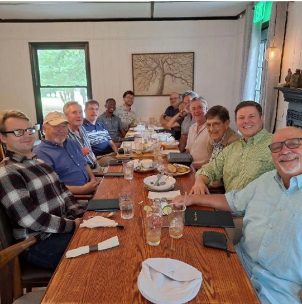
Part of what helps with this connection is that Centenary has a wide variety of small groups that anyone can participate in. They host two groups, Community Group and Bible Study, in a hybrid format, allowing someone to join either in-person, or on zoom. This makes these groups more accessible to some individuals. More Centenary specific groups though include their “‘Ladies’ Luncheon” and “Single Servings Group.” The “ladies” luncheon is an event for gay men and their friends to get lunch together and converse on the first Sunday of the month. The single servings group is for single adults over 60 to meet up with each other on a bimonthly basis. For the wider Macon community, Centenary also hosts AA and parental accountability meetings within their buildings. In addition, they have an industrial size fridge that they use to house all the food they serve to Macon, such as sandwiches they make every Thursday and free breakfast on Sundays.
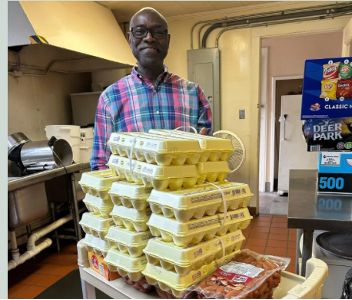
Centenary prioritizes outreach. For instance, they have free breakfast every Sunday morning, prevent protestors from interfering with pride parades, and support recovering drug and alcohol communities. Additionally, the church also provides food for homeless animals, a bike program for those who don’t have a form of transportation, and showers and clothing for those in need. At the beginning of every service, announcements are presented for community members to participate in various forms of outreach. Also, during every service offerings are collected, community members have the option to donate cash in the baskets that are passed around or use the QR codes on the programs to donate electronically. It is evident through all their outreach that the money collected from these offerings is being poured back into the community.
Centenary United Methodist Church has created a community that prioritizes inclusion and action. Their emphasis on all being welcome and included blend together in their worship, service, and outreach. From the moment any person enters the building, they are treated and welcomed as though they have always been part of the congregation. The church’s values are not only seen by how they welcome newcomers to their service, but also how services often connect scripture to real-world issues, and their continuous community outreach that goes far beyond worship. It is evident that Centenary Church deeply cares for its members and their surrounding community.
Danica Dilione is a junior double majoring in Theatre and Media Studies.
Michelle Reynoso is a sophomore majoring in Public Health.
 The Macon Religious Communities Project