

A Community Worth Protecting
November 19, 2025
None of us came from Jewish backgrounds, so stepping into the synagogue was an entirely new experience for us. When we parked beside the building, we thought we had gone to the wrong place. It appeared empty and there was not a car in sight. We walked up to the door together and knocked. It only took a few seconds for the door to swing open, and the security guard let us in. The gun on his hip and the fact that we had already had to email in visitor forms made us more cautious than usual. We worried that the extensive security measures meant they would be guarded around strangers, but their hospitality soon corrected us. Through our visits and time with the congregants of Congregation Sha’arey Israel, we soon found out they had a lot worth protecting.
As we waited for congregants to trickle in, the security guard gave us a tour of the property. The tan, unassuming building was purchased in 1919 and completed in 1922, after the congregants had spent years renting public meeting rooms to hold services. The main room of the original building was the large sanctuary, where services are held during the holidays and the times of highest attendance. Large front doors led into an auditorium lined with stained glass windows depicting verses from the Torah.

We spent our time in the smaller sanctuary, which was added later. It was less than half the size of the large sanctuary, but it felt bright and airy with natural lighting. The security guard then took us on a walk around the building to the garden, fenced in by an intricate metal gate featuring a beautiful tree.

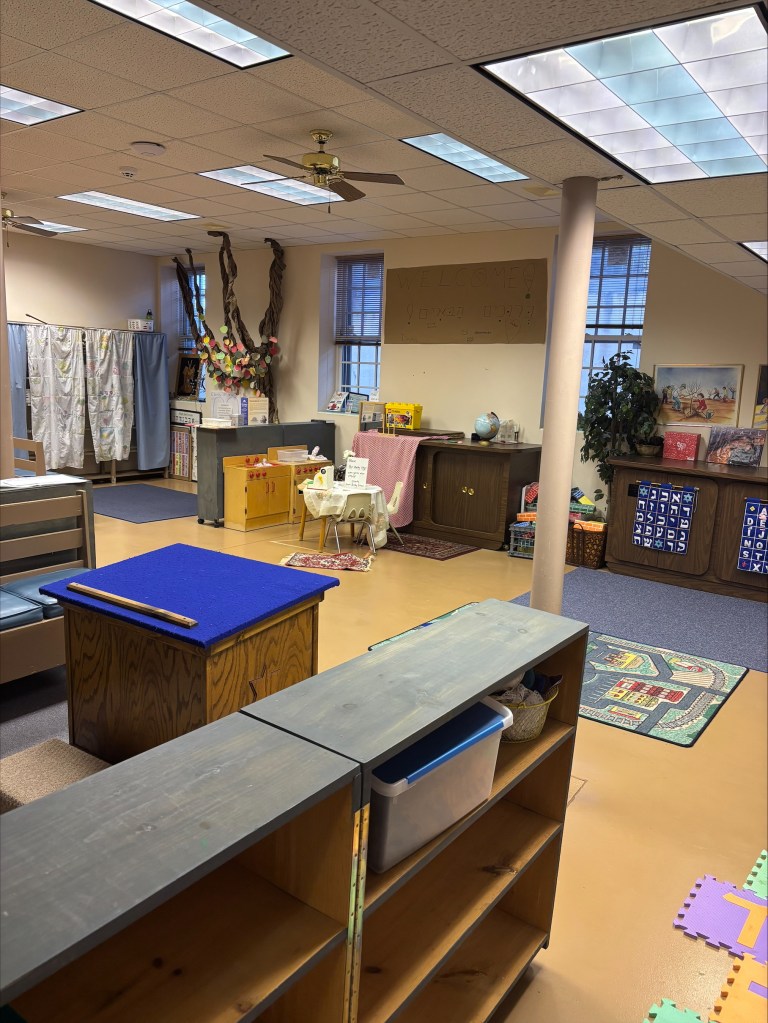
Along the way, he pointed out some flowers that the congregation’s children plant each year. He also showed us the children’s school rooms downstairs, and we ended the tour in the lunchroom, where he offered us coffee while we waited.
After we finished our coffee, the security guard peeked his head into the lunchroom to let us know the service was starting. As everyone greeted us, they gifted us a jar of their very own honey, as the Rosh Hashanah festivities were approaching. We were all concerned about whether we’d be able to follow along, especially with the Hebrew readings and songs, but Rabbi Aaron Rubinstein and the cantors led us through every step of the way. They handed us all the prayer books we would need at the very beginning, and announced each page change and new passage to make sure we knew the order of proceedings. He took time to explain everything about the service, even everyday practices that other congregants would be familiar with. He did not simply make sure we knew what was going on, but he also invited us to participate wherever possible. We couldn’t read passages of the Torah, of course, but we were welcomed to come up and look at it when it was brought out of the ark. Though this sanctuary was much smaller, that made it feel more personal. We felt closer to the attendees, free to ask and answer questions along with them during the sermon. Not once did we feel lost in the service.
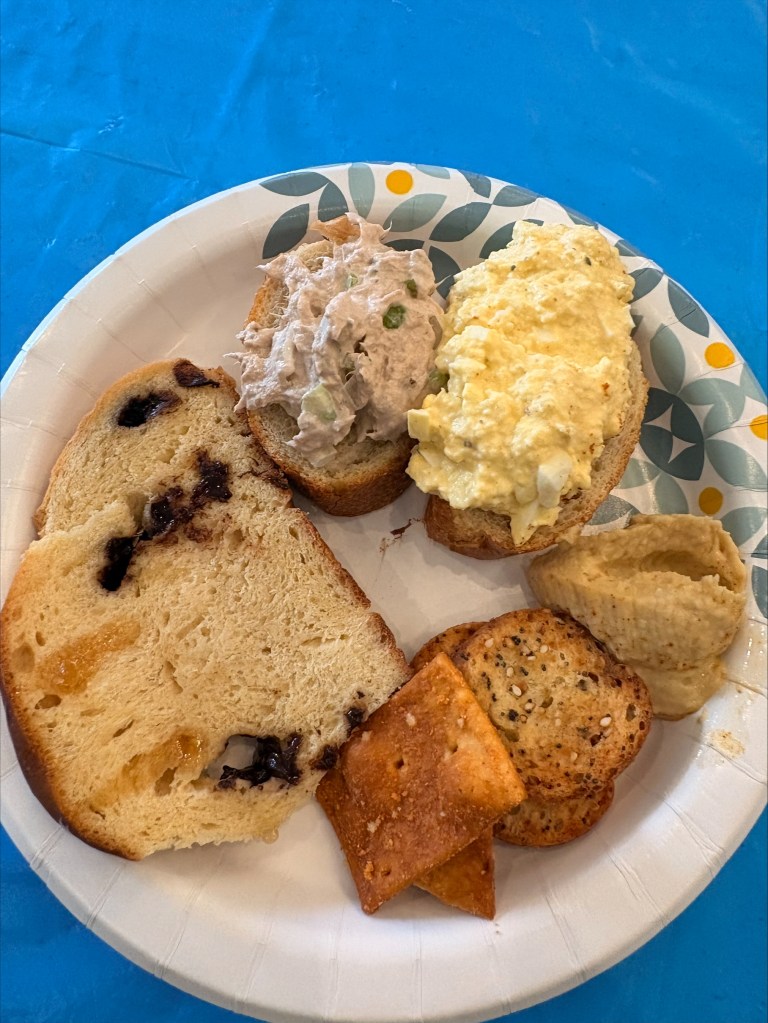
After the service they congratulated us for making it through our very first Shabbat, and welcomed us back to the lunchroom. Cups of grape juice and various wines and whiskeys were set out for a prayer before lunch. We sat down with them for a full meal, cooked every week by one of their members, along with some freshly-baked challah bread with honey and chocolate.
Sha’arey Israel is small but mighty in many ways, and one of their biggest strengths lies in their commitment to community service. We had no idea how far their impact in Middle Georgia went until we talked to members of the community. While we were attending the congregation’s Sabbath service there was mention of volunteering activities that were happening every week. For example, each year the upcoming bar- and bat-mitzvah students must prepare a project that has meaning within their middle Georgia community. In an interview with a member, we learned of a girl whose project raised donation money for a Menorah-lighting service held in Perry. When we asked another member about community involvement in Macon, she discussed her husband, “he goes and makes sandwiches and snacks for [the hungry] every Tuesday. He [also] helps in, along with the Temple, I think it’s the third Thursday of the month, they serve food over at Macon Outreach, where they feed the hungry.” This is one among several other organizations they partner with.
A major figure of community service is their very own Rabbi. From playing the accordion to making hot sauce, the Rabbi does it all. Rabbi Aaron plays the accordion with bands in Macon and in the surrounding areas. Not only is he involved with the Macon music scene, he also grows his own peppers and sells homemade hot sauce. Instead of pocketing all the money from sales, he includes a QR code at the bottom of the bottle for the proceeds to go to local causes. Like others in the congregation, he also helps package meals for the homeless. Congregants boasted that he has spent the night with Macon’s homeless community, in order to raise awareness and keep them company. He sets the prime example of what it means to lead in a congregation and a community through service.
Sha’arey Israel has supported the Macon community enormously, but it has also learned to lean on Macon as well. Around 2023, a Neo-Nazi group came to Macon to spew hateful rhetoric. 10-15 demonstrators brandished horrifying signs and even hung an effigy. The situation was so dire that the FBI stepped in. Until they got on the case, the Jewish and Macon community’s collective response kept everyone safe. When one member of the congregation brought it up, he remembered,
“yeah, it was intense. But like I said, the community as a whole, not just the synagogue, but… you know, the other synagogue, the churches, the mosques, everybody came together and said, you know, basically not in our town, and stood literally.”
When he was asked later what his favorite moment was, he again brought up the whole town’s response to this incident. It really cemented in his mind that he wanted to stay in Macon and with his synagogue. Not only did Sha’arey Israel stand up in counter protest, they also hosted classes on how to calmly deal with hate and remain safe. The counter protest brought everyone together to protect Macon’s two synagogues. Without the roots that Sha’arey Israel has built within Macon, the outpouring that this member described wouldn’t have occurred.
This also would not have been possible if the congregation did not trust each other so completely. Their strong bonds were formed and reaffirmed over the years as they faced different hardships together as one community. Rabbi Aaron confessed that the pandemic was a particularly rough time for Sha’arey Israel, and it has not recovered to its fullest extent–but the relationships they already had were strengthened even more. Over lunch one Saturday afternoon, Rabbi Aaron shared heartfelt stories of how the congregants supported him and each other during this time. One morning before Rabbi Aaron livestreamed the service alone from the sanctuary, some congregants had conspired to fill the seats with cardboard cutouts of themselves. It was supposed to be a joke, as the cutouts had disproportionate heads and even included some of their favorite celebrities, but Rabbi Aaron said he immediately broke down in tears. The little gesture went a long way to show how the congregants were still there for him.
Whenever they had a Zoom meeting, congregants loved to show off their pets. This showed a new side of each other’s lives that they were not used to seeing when they met in the synagogue. During our visits we met a teenage girl, who was young during the pandemic. She had a pet lizard that she would always show off on camera whenever she attended anything online with the congregation. Congregants always looked forward to seeing the lizard, and it became her own little symbol. Eventually when she had her bat mitzvah, the congregation commissioned a quill shaped like a lizard especially for her. These kinds of charming stories got a laugh out of everyone around the table as they all chimed in with what they remembered.
The congregants do not just show up for each other during hard times, but also during everyday life. One of the congregants mentioned how he had simply hinted he was sick in a joke on social media, and without warning some of the congregants showed up at his house sporting chicken soup and banana bread. These little things go a long way toward making everyone feel appreciated. No matter how big or small the problem, someone from the congregation is always willing to step up and help.
We were incredibly lucky to discover such a caring community through this project. Even though two of the researchers grew up in the Macon area, meeting the members of Sha’arey Israel opened up a whole new side of the city for us. The congregants do incredible work for this town we call home, both day-to-day helping those in need, and occasionally supporting those in crisis. They are a small group, but their impact stretches far and wide. Though they are all very close, everyone we spoke with went out of their way to include us and make us feel welcome, even inviting us to events outside the scope of our project. We uncovered a vibrant new community, but we know we just scratched the surface of Sha’arey Israel’s influence in the world around it. We’ve done our required attendance, but we would love the chance to go back and visit this treasure of a synagogue in the future.
Emily Grant is a sophomore, majoring in political science.
Mary Emma Ridley is a sophomore, majoring in biology and classics.
Jenna MacNaughton is a sophomore, majoring in nursing.
 The Macon Religious Communities Project