

Faith and Community at Macon’s First Presbyterian Church
November 19, 2025
First Presbyterian Church (FPC) plays a central role in the religious and social life of downtown Macon, as weekly Sunday services provide consistent opportunities for individuals to gather and practice their faith. During our visits, the church’s commitment to community was shown through how the congregants greeted us as newcomers, engaged us in conversations about our backgrounds to help us feel at home immediately. This, and many other examples, help demonstrate that First Presbyterian Church is a multigenerational church that exemplifies and fosters an authentic community amongst its members while also providing opportunities for spiritual growth.
First Presbyterian Church was founded on June 18, 1826, in Macon, Georgia, by Rev. Benjamin Gildersleeve and Rev. Joseph C. Stiles. The original church was wooden and was later sold to the Baptists. The current building was constructed in 1858 and was called the “Romanesque Revival Building.”
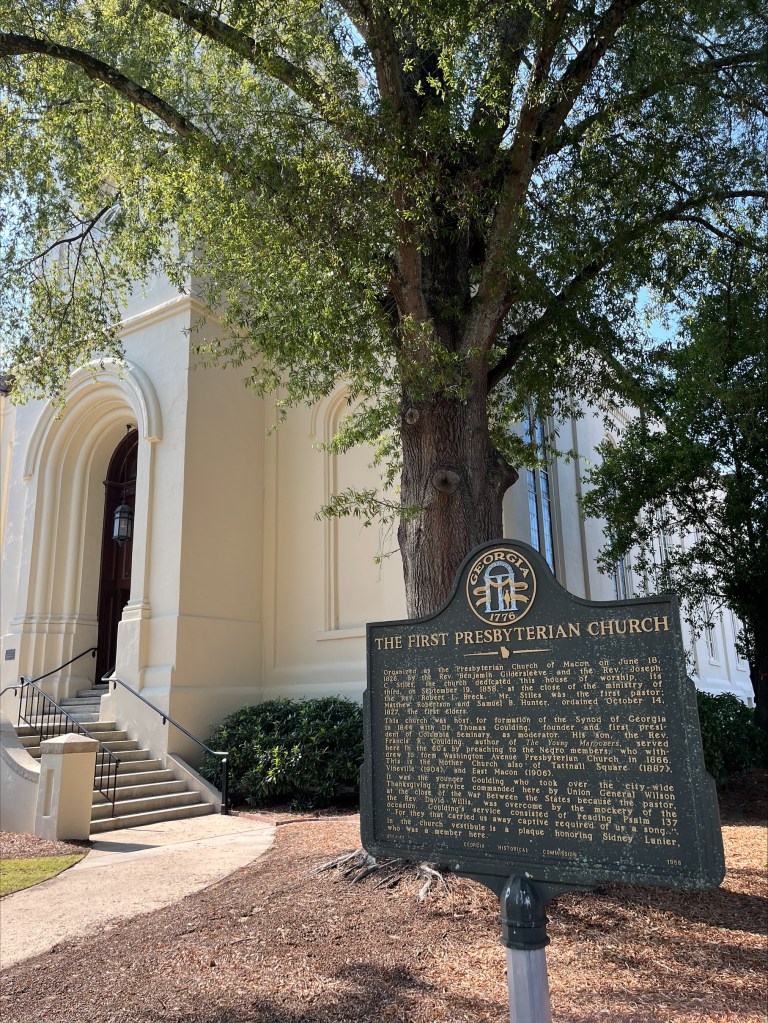
Throughout its history, the church has hosted many significant events, including the formation of the Synod of Georgia in 1844, a sermon to African American members in the 1860s by Rev. Francis R. Goulding (the author of The Young Marooners), and a Thanksgiving service led by Goulding that was ordered by Union General Wilson. In addition to this, the church is also the mother church of Vineville, Tattnall Square, and East Macon. Notably, an interesting fact that one of the leaders shared with us was that a copy of the Emancipation Proclamation was read on the steps of First Presbyterian. The church will continue its legacy in 2026, when it celebrates 200 years as a congregation .
First Presbyterian Church is a member of the Presbyterian Church in America (PCA). The PCA was founded in 1973 as a denomination that describes itself as, “Faithful to the Scriptures, True to the Reformed Faith, and Obedient to the Great Commission.” PCA churches believes in the Holy Trinity (God, Jesus, and the Holy Spirit), salvation through Christ alone, that all humans are sinners, and in the afterlife in either Heaven or Hell. PCA-affiliated churches in Macon differ from those affiliated with the Presbyterian Church (U.S.A.) (PCUSA). Both denominations are rooted in the Protestant Reformation, but they have some distinct differences in their beliefs. Generally, the PCA takes a more conservative stance on social issues while PCUSA takes a more liberal stance.
Located in downtown Macon across from the Grand Opera House, the First Presbyterian Church stands out with its tall two-story structure with a white exterior, black accents, such as the roof and the downspouts, and its neatly trimmed lawn. There are large trees surrounding the exterior with many smaller bushes with different colors of flowers underneath. The church is surrounded by black metal fences and has a big sign at the front of the entrance with its name. During our visits, construction was ongoing, so scaffolding was visible around parts of the building. Parking in front of the church was limited, but we found out that there are additional free parking lots on Cotton Ave, on Sundays only, which is only a 5-minute walk from the church.

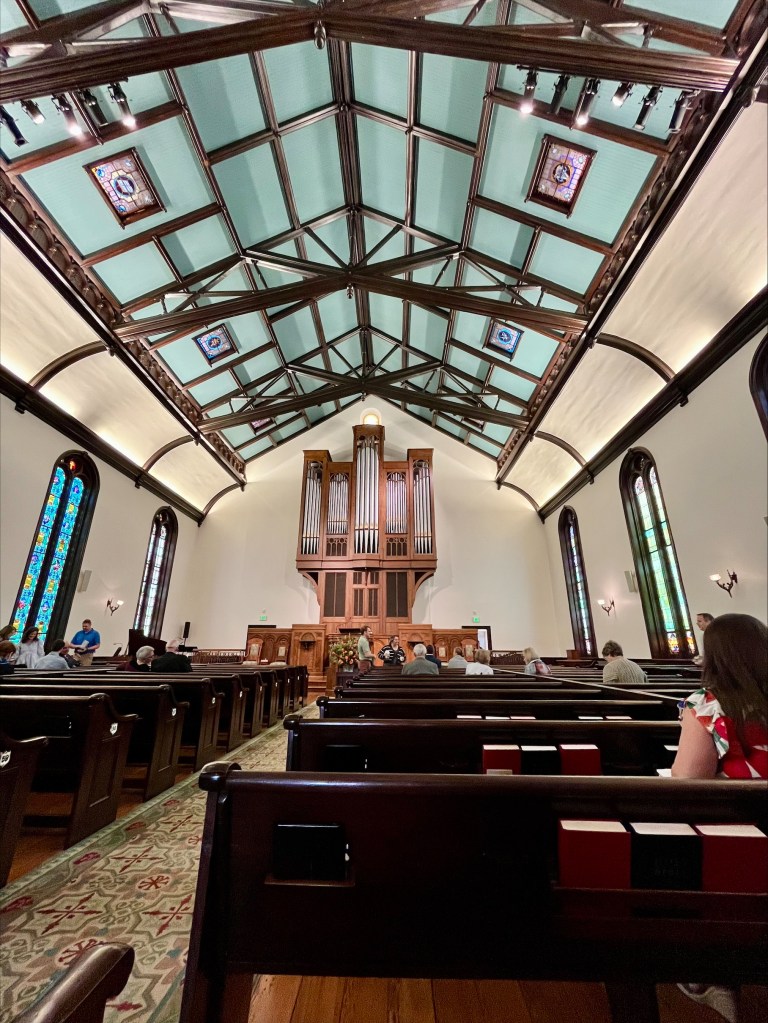
Tall, stained-glass windows fill the sanctuary. In addition, surrounding it are lights in the shape of torches, lighting up the main room. The layout of the church consists of four rows of chairs with two pathways in the middle for walking. But aside from this, the main focus of attention points to the big stage at the front. There were flowerpots and hanging baskets and decorations at the front, a wooden piano, a choir stand, and most distinctively, a big, tall organ. On one of the Sundays we visited, it rained, which caused the church to become darker than usual because the main light source usually comes from the sun that shone through the windows. But despite that, the church became homier and cozier. Overall, the setup remained relatively consistent throughout our visits: a formal and peaceful worship place.
During the first two visits, the congregants appeared to be mostly older, predominantly white members, with only a few younger families and students attending each service. But on our third visit, the proportion of the demographic changed, as there was a more equal representation of older and younger people. Although most of the congregants are white, a small number of families with different ethnic backgrounds were present each week. There were some West-Asian, African American, Hispanic, and East Asian families that were present. Over the course of our visits, there were roughly 250 people present.
The dress code was business casual. Middle-aged men or male teens would typically wear button-down shirts, collared shirts, quarter-zips, or dress shirts with either khakis, black, or gray dress pants or chinos. Older men, on the other hand, would wear a full suit with a tie or a bow tie. For women and young teenage girls, they would usually wear long dresses, a nice blouse, or nice dress pants. They would also have their hair and makeup done. None of the congregants wore jeans, shorts, or plain T-shirts except for one group of students we observed on the third visit, which stood out because the church’s dress style was very traditional. Furthermore, the members here were very welcoming. Several members approached us each week to introduce themselves, ask about our backgrounds, such as why we are here and where we came from, and engage in conversations. Each of them went out of their way to welcome us. Overall, the congregation can be described as very tight-knit and kind.
There are many leadership positions at First Presbyterian Church. The senior pastor is George W. ‘Chip’ Miller. He has worked at FPC since 1987 and has served as senior pastor since 1994. For the three times we visited, he preached every time.
The church is known to have a tight-knit community. After services, everyone mingled with each other and at least two leaders. Checking in on everyone seemed routine. Not once did we see anyone leave without saying goodbye or thanking the members and leaders for the service.
During our last visit, we had the opportunity to speak with and interview Chris Gerwig, who explained that his leadership style is largely based on the needs of the people in the congregation, asking questions such as: “What will help this community thrive?” and “How can the congregation gain more devoted members?” He also talked about loving people and teamwork. In our interview, he expressed,
“As I have matured, the more I’ve seen is [that] if you’re going to really love people and you’re going to help them build community and you’re going to help equip them in their uniqueness and in their gifts, [then] part of that means developing the process.”
Teamwork, he explained, not only gets things done faster and efficiently, but it also brings multiple ideas together to come to the best final decision. Overall, teamwork brings everyone closer while also being beneficial to the community.
First Presbyterian Church has a variety of ministries that it uses to build community in its congregation. On Sunday mornings, the church have several small groups that cater to different ages, specifically for children, youth, young adults, seniors, and even prospective church members. They also have small groups that are a combination of different ages. These small groups focus on a variety of topics ranging from the New Testament, specific books of the Bible, or specific topics like marriage and Christian doctrine. On Wednesday nights, FPC builds community through fellowship meals, which are followed by youth ministry gatherings and adult small groups. These small groups are different from Sunday morning ones. For adults, they have two co-ed groups, a women’s prayer group, a grief group, and a career and grad group (18-year-olds to 35-year-olds). Elementary-aged kids meet for Bible study, games, and choir practice. Furthermore, the youth also meet for a time of worship that consists of games, singing, and small groups. The authenticity of the community at FPC is displayed through the relationships between church members. Each time we visited, it was clear that the church members knew and cared about each other.
Outside of their typical Sunday morning and Wednesday night programming, FPC seeks to build community through various events and retreats. They have some events that are focused on the entire congregation, such as outdoor services, ski retreats, father and daughter’s dance night, and Christmas Eve services. One church member said that the Christmas Eve service is “one of the best community-focused parts of church.” FPC also hosts events that are catered to specific groups. Some examples include men’s retreats, women’s dinners, new parents’ brunch and night out, conferences, and youth parties. First Presbyterian Church’s emphasis on building authentic community is displayed in its commitment to providing opportunities for fellowship.
First Presbyterian Church holds Sunday morning services. They have one service at 9:00 a.m. and one at 11:15 a.m. with Sunday school in between at 10:10 a.m. FPC’s services are traditional and structured. Typically, the service began with the piano or organ prelude as the choir entered. A pastor then came in, welcomed everyone, and shared announcements before leading everyone in a call to worship. Afterwards, the congregants rose and sang one or two hymns together. The song’s lyrics were very accessible and could be found in the bulletin, which is handed out at the beginning of the service. The hymns were accompanied by either the organ or piano, and on occasions, other instruments as well. After a hymn or two, one of the pastors led everyone in a time of confession of sin. Sometimes this portion was silent, but other times it was a group confession where everyone read a paragraph printed in the bulletin aloud. Afterwards, another hymn was sung. Then, there was a dedicated time for giving. The choir usually sang a special song during this moment. Lastly, the Senior Pastor preached a sermon, followed by another hymn or a benediction to end the service.
During the service, as the piano played, the congregation takes a moment toward the middle or end for the ushers to walk down the rows and collect the money given by members. Some may not give their money in cash but pay through the QR code given within the service pamphlet. During our last visit, money seemed to be somewhat the main topic of the pastor’s service, as senior pastor Chip Miller strongly suggested that members donate, and if they have not taken and bought their pledge, to do so. This all is because First Presbyterian is working on a community project (First 4 All) that was first proposed 30 years ago and officially launched in early 2025. The project is expected to be completed at the beginning of 2026, and the church aims to raise five million dollars by then. The money raised will be put towards helping the church and community be reconstructed, offering additional events, activities, and more.
Through its tight-knit community, weekly services, and its desire to give back to the community, it is no shock that First Presbyterian Church has been one of the most prominent churches in downtown Macon for almost 200 years. The services, which include music, prayers, and giving, reflect the congregation’s commitment to spiritual growth. Furthermore, its ministries, small groups, and special events help strengthen the connections of the congregants across different generations and backgrounds. Together, First Presbyterian Church helps exemplify and foster an authentic and multigenerational community, while also supporting its member both spiritually and personally.
Chloe Wilson is a sophomore majoring in Nursing.
Helena Burton is a sophomore majoring in Secondary Education with a focus on Mathematics.
Sang Tran is a sophomore majoring in Biology on the Pre-Pharmacy track.
 The Macon Religious Communities Project