

Acceptance and Community
November 19, 2025
Temple Beth Israel, one of two Jewish congregations in Macon, Georgia, stands out for its long history, Reform Jewish identity, and reputation for inclusion. The moment people step inside, the community’s openness sets Temple Beth apart from many other religious communities. Their welcoming atmosphere is not incidental, but is deeply rooted in the congregation’s century-old history and reinforced by the leadership of Rabbi Elizabeth Bahar, whose emphasis on compassion, communication, and belonging shapes the Temple’s congregation.
Temple Beth Israel has been a part of the Macon religious landscape for over 150 years, steeping it with a rich history and tradition. According to their official website,
“The first synagogue is described in the minutes as ‘a room in Cherry St. over Horn’s Confectionery, and which we think a desirable and central location. The size of the room is 50 feet in length by 28 feet in width, with gas already put in…”
This location served as the congregation’s first place of worship till 1874. During this period, the community constructed a new Temple and they moved into their new location on Poplar and Second Street, where the ever-growing Jewish community worshiped and served the community. This Temple served as a home for Temple Beth Israel for about twenty-five years. During that time period, Macon grew and flourished, bringing with it a weekly farmer’s market on Saturday mornings. The noise in the streets from the wagons and the unwanted smells from the livestock kept the congregants from being able to open the windows, creating a difficult environment to focus on worship. With no air conditioning to cool off the building, one can imagine how unbearable it was to keep the windows closed. So, in 1902, the first services were held in the new Temple on what is now the present property on the corner of Cherry and Spring Street.
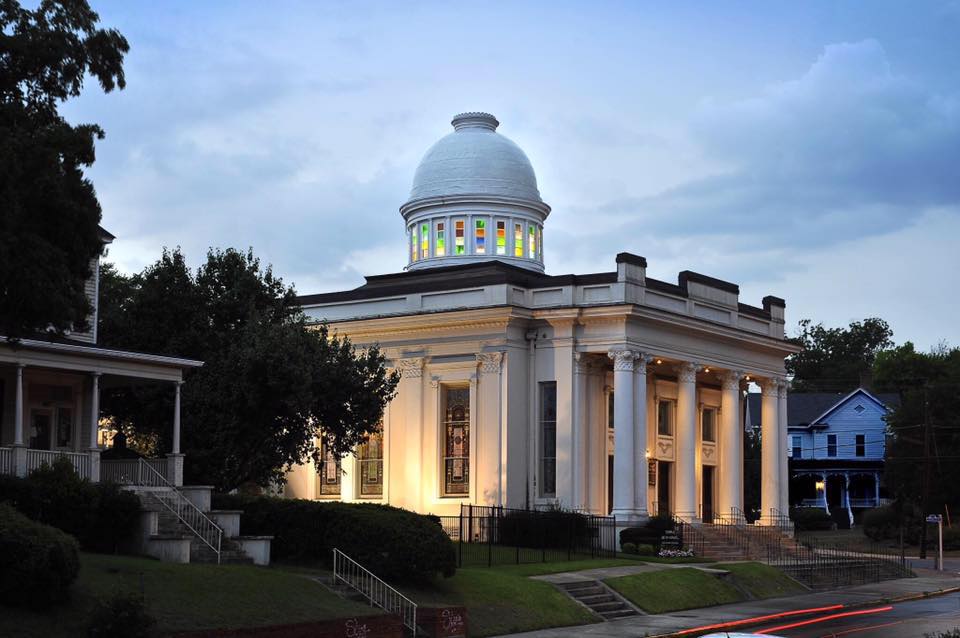
The landscape around Temple Beth includes a small park across the street, with various brick structures. There is parking behind the Temple, and when visitors arrive, they enter through the back door. The front of the Temple has three solid wooden doors with stained glass windows over each one. There are twelve pillars in total around the Temple entrance, with six supporting the awning and six that are decorative. Upon entering the Temple, there is a small hallway that leads into a foyer that has a table with pamphlets discussing the Temple and offering information for visitors on top, as well as a Jewish Calendar. Additionally, there is a glass cabinet that has artifacts and historical mementos from Temple Beth Israel inside. Situated in the middle of the room, there are two sofas and four chairs arranged in a circle that serve as a gathering place before the start of the service. As you walk through the room, it opens to a dining room area that is twice the size of the first room that houses a small gift shop in the corner. The congregation gathers weekly in the dining room after services for fellowship and refreshments. As visitors, we were greeted warmly and offered to partake in the refreshments after service, regardless of our beliefs or background.
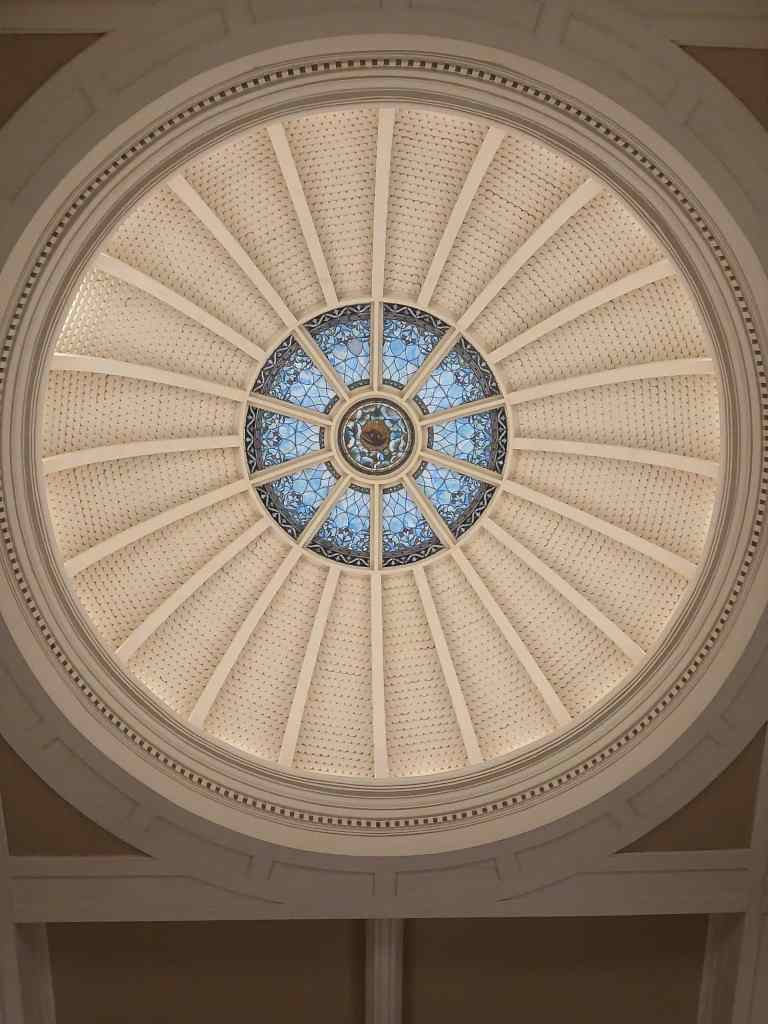
Services are held in the Sanctuary, which is near the front of the Temple. It has a dome-shaped roof, much like that of the United States Capitol Building, with a stained-glass ceiling. The image in the center of the stained glass is that of an eye, which depicts “The Eye of Elohim.” This was explained as the eye of God, who is always watching over you. An older man explained that no matter where you move around the sanctuary, the eye is always looking at you. The light glows through the eye instead of the blue glass around it, really exaggerating the feeling of being watched over.
Other features within the sanctuary that offer depth to the worship of the membership of Temple Beth Israel include seven stained glass windows that depict the six days of creation, as well as stained glass windows that depict famous stories from the Torah, the Jewish Sacred Text. At the front of the Sanctuary, on the stage, is a special wooden box with brass doors housing the congregation’s Torah scrolls. The scrolls were clothed with special garments, which were changed from white to purple for the High Holy Days. The doors are adorned with menorahs and slide open to reveal God’s Word to the congregation.
Temple Beth Israel is led by Rabbi Elizabeth Bahar, who has served the community for the past five years. She came to Macon through a search process initiated by the synagogue, where she interviewed with the congregation’s committee before being chosen to serve as their spiritual leader. Though her story of arriving at Temple Beth Israel may sound simple, even by her–“They said, ‘Would you like the job?’ and I said, ‘Yes,”–her leadership has become a defining feature of the congregation’s identity and warmth. Rabbi Bahar’s path to becoming a rabbi was not straightforward. As she explained to us, she originally went to Brandeis University with the intention of becoming a doctor, but quickly realized that medicine was not going to work out. “Turns out I don’t like blood,” she joked. However, she did end up finding herself drawn to Jewish life and study: “I found myself just taking Jewish study classes for fun, volunteering in the synagogue, teaching in Sunday school, and I was like, okay, if this is what I’m finding myself doing, then I think I just want to be a Rabbi. That was it.” This sense of natural calling and community orientation has influenced her ever since.
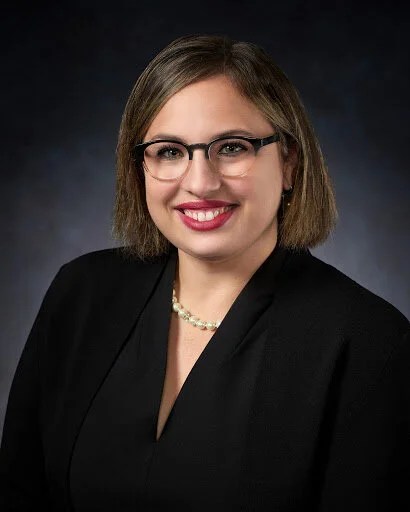
When commenting on her leadership style to us, Rabbi Bahar reflected on how it has evolved. “I think as I evolved, so has my leadership,” she said. “I used to be much more rigid when I first got out of seminary, as all kids do when they graduate from school.” Over the years, she developed a more conversational, inclusive, and warm approach to leadership and community engagement. Rather than leading at a distance, she focuses on personal relationship building with her congregants and encouraging connections among them. “I try to be as inclusive as possible and get to know as many of them as possible,” she explained. She told us how she has coffee chats with members to get to know them and keep the peace within the community.
This emphasis on inclusivity is central to Temple Beth Israel’s culture under her leadership. “We’re really good at being kind and welcoming of people, regardless of how they identify within our space.” She estimated that around 20% of the congregation identified as LGBTQIA+, about double the percentage found in the population of most religious spaces. “That’s probably abnormal compared to other congregations,” she said, but it reflects the Temple’s open and affirming stance. At the same time, Rabbi Bahar acknowledges the past and present challenge of attracting younger members, an issue shared by many communities. “We’re aging,” she admitted. “Always looking to find ways to attract young people. And I don’t know the answer.” Challenges aside, Temple Beth Israel thrives on their strengths of inclusion and belonging that Rabbi Bahar cultivates, which even first-time visitors notice. As one of our group members, Jezie, reflected, “I was really nervous coming in because I didn’t grow up religious, but everyone was so sweet and welcoming. I felt at home right away.” Rabbi Bahar smiled at that comment, responding, “I make sure everyone plays well in the sandbox—but I don’t advertise that.” Her humor, empathy, and behind-the-scenes work clearly help keep up a peaceful and cooperative spirit within the community.
Like many congregations, Temple Beth Israel faced major obstacles during the COVID-19 pandemic, which began right after Rabbi Bahar arrived. “For a year and a half or so, we were just online,” she recalled. “I would send my congregants cards, call them every six weeks, see their boxes on Zoom, and we did some stuff in the parking lot.” Leading worship through a screen was challenging, especially for a new rabbi still getting to know her community. “It was definitely a different time,” she said. Yet she was dedicated to connection even from afar, helping members through isolation.
One of the most impactful moments in Rabbi Bahar’s time at Temple Beth Israel came when a Nazi group targeted the synagogue. “The stupid Nazis came and did their thing,” she recounted bluntly. “They marched in front of us and hung a Jew in effigy—a gay Jew. It was terrifying.” But what followed showed the strength of their community and Macon. Members of Temple Beth Israel and the broader Macon community came together in solidarity and stood with the congregation. “Every time I’ve had a need, like when I need volunteers, people show up,” she reflected. “That was the one that kicked it off. After that, we all bonded deeply.” Through this challenge, her leadership and the community helped create unity. Today, Rabbi Bahar continues to guide Temple Beth Israel with openness, and as she puts it, “We’re super chill. We are not rigid.” That ethos of being welcoming, authentic, and community-oriented defines her leadership and the life of the congregation she serves.
This ethos shows up a lot in the style of service offered at Temple Beth Israel. Services are designed to be inclusive and participatory, blending Hebrew and English prayers so everyone can feel included. Shabbat services are held on Friday evenings in the main sanctuary. The service experience is both spiritual and social. Rabbi Bahar leads with a conversational tone, often weaving humor and reflection into her sermons. Prayers and blessings alternate between spoken and sung, fostering a rhythm of community involvement as there is no choir, so everyone joins in to make it impactful. At the end of services, congregants gather for Oneg Shabbat, an informal reception featuring challah, refreshments, and lively conversation. These services reinforce the congregation’s emphasis on connection and belonging. For many members, worship at Temple Beth Israel feels refreshingly relaxed compared to more formal or traditional settings. One student observer, raised in a Catholic church, described the difference as “like night and day,” noting that Temple Beth Israel’s services were “so much more fun” and welcoming. Rabbi Bahar embraces this informality as part of the Reform movement’s inclusive approach. That openness extends to all aspects of the temple’s spiritual life, from welcoming interfaith families to affirming LGBTQIA+ members, and ensuring that newcomers, whether Jewish or not, would feel comfortable participating.
Through this style, Temple Beth Israel has cultivated a tight-knit community among one another. Everyone knows everyone, and they knew a lot about each other. Every time we attended the service, there would be one or two new people to us, but they were never new to everyone else. When we talked to two younger members of the congregation, they gave us a lot of insight into the community within the congregation. They talked a lot about a several specific people, but mostly about this one older woman. They mentioned that she had been going since she was a little girl, and her family had been attending for generations. We later met her, and she invited us in with open arms and helped us out when we did not understand something that was happening within the services. The other members were very inviting as well. They never made us feel like outcasts or like we didn’t belong, which was something we were a little worried about coming in. From the minute we walked in the door, people were striking up conversations with us and inviting us to have a seat with them. Members of the congregation would always be seen having in-depth, long conversations with one another. These conversations they had ranged from upcoming events, health of family and friends, and just basic small talk, but it always showed how much they cared.
The congregation members were all very willing to help explain things we did not understand. They were always willing to teach us something. Many times during the services, we struggled to follow what was happening, because they were mostly in Hebrew and we had not experienced anything like them before. The first time we went the older woman invited us to sit with her so she could help us and the second time an older man sat next to us and helped us out. We got to see the Torah multiple times and had the Rabbi and the older man previously mentioned talk to us about them.
In our interview with the two younger members, we learned about a time when one member had been in a motorcycle accident. The entire community came together to help him and keep tabs on how he was doing and his healing process. Within the Jewish community, there is a blessing called Mi Sheberach. This is a prayer for the sick and injured. They recite this prayer at almost every service, but they had specifically done it with this member in mind. They also have another prayer called El Maleh Rachamim, or the Mourners’ Kiddish. This prayer is also said at almost every service with an invitation for people to say the names of individuals they were praying for. This happened many times during the services, which opened up a topic of conversation after the service. These prayers were a way for congregation members to remember those who have passed and invite others into their lives.
The congregation is heavily involved in the community outside of the Temple. Almost every visit Rabbi Bahar made announcements at the conclusion of the service about things going on in the community and within the congregation. One of the primary things they were doing was collecting food for the homeless shelters around Macon. They sent home bags with each member and requested that they bring in non-perishable food items to give out. Similarly, they hosted Sunday sandwich-making with the DSA, the Democratic Socialists of America. One of the leaders is a member of Temple Beth, and she spoke very highly of the organization. Each week many congregation members come in and make peanut butter and jelly sandwiches for the homeless shelters and community fridges.
Temple Beth Israel, like many religious communities, faces challenges as an aging congregation desiring to attract more young people. Even so, they continue to be a beacon of the Macon community. Rabbi Bahar and the community are committed to adapting and remaining that community beacon. Visiting Temple Beth was an eye-opening experience for all three of us. We were grateful to be able to visit and become part of their family.
Sana Bruno is a sophomore majoring in Biology,
Lanise Baer-Hudson is a junior majoring in Fine Arts.
Jezie Garmon is a sophomore majoring in Biology and Criminal Justice.
 The Macon Religious Communities Project