

Faith, Community, and History
April 10, 2026
There is a plethora of churches within the Macon area, but none are quite like St. Paul’s Episcopal Church. From the kind churchgoers and colorful church decor, there are many strengths of this congregation. The congregation is unique in how it fosters community by utilizing its physical form to further tell a story. From the stone path and florals surrounding it to the wooden doors, the visual aspect of the church really works in harmony. It is a historic space where the architecture and surrounding nature work together to shape and form this historic Macon community.
The history of the community at St. Paul’s Episcopal Church runs deep. Understanding the origins of these congregations can give insight into how this church has remained standing over 100 years later. During an interview with long-time churchgoers, we learned a lot about the community.
In 1869, the members of St. Paul’s Episcopal Church met in what was once a railrailroad terminal, weekly seeking the word of God and communal support. It was not until 1889 that the current Sanctuary was constructed with the same bricks used for the road terminal. The other building of St. Paul’s Episcopal Church, called the Canterbury House, dates back to 1870, when it served as the Appleton Orphanage. During the Civil War, many families experienced separation hardships. Little girls who were left without a place to call home and families to embrace them were brought to Appleton Orphanage, where the church housed and fed them. Togetherness and supporting those in need have become foundations of the church.
Though the church has a history of helping others, there have been moments when St. Paul’s needed assistance, too. Like many congregations during the Great Depression, the church ran into financial problems. At one point, the note for the mortgage of the church could not be met, risking eviction. A group from the neighboring synagogue was informed of the issue and offered to provide financial aid. This group helped meet the mortgage note for St. Paul’s, demonstrating its relationship with other communities of faith in Macon.
In 1950, during the pre-Civil Rights era, segregation was a rampant issue that kept many churches from being united. As Martin Luther King Jr. infamously said, Sunday at 11 o’clock is the most segregated hour in America. However, it was not for St. Paul’s and St. Matthew’s Episcopal Church, a historically Black Episcopal congregation in Macon. The predominantly white congregation of St. Paul’s often invited many ministers and preachers from St. Matthew’s church. This act of integration was something considered “out of practice.” Despite that, St. Paul’s welcomed St. Matthew’s Episcopal Church with open arms for Sunday service, where people shared their love for the Bible and communed. Such a progressive action was demonized by the public as St. Paul’s was met with scrutiny and even received death threats.
A significant part of St. Paul’s modern identity is its international inclusion of the Hispanic community. The Canterbury House is now used as the space where the Hispanic congregation gathers to worship, meeting on multiple Sundays of each month. However, St. Paul’s support goes beyond their Sunday mornings; the church empowers its members that are a part of the Hispanic community by providing resources, including English language classes, skills training, and helping those who are working towards their GEDs. This approach ensures that the church is not just a place of worship, but a center for personal and professional growth.
In addition to housing a Hispanic community in their congregation, St. Paul started three other congregations in Macon. There are many support groups like Alcoholics Anonymous, Narcotics Anonymous, and Al-Anon. Other outreach programs the church participates in are sponsoring Loaves and Fishes. According to members, St. Paul’s sets aside 10% of its budget for outreach to the community.
Just around the corner of the church are the high-rise St. Paul Apartments and St. Paul Village. This congregation started the first high-rise in Macon. It is a secure and safe facility for all residents. Depending on their income, the seniors receive one-bedroom apartments. If they want to play bingo, there is a chance for that too every Monday night. The church has a Birthday Card Ministry where they not only make birthday cards for one another, but also for the residents of the apartments.
During our visits to the congregation, we were struck by the path leading up to St. Paul’s church. The path is a brief but beautiful transition from the secular into the sacred. Walking from the parking lot, visitors are greeted by floral bushes and vibrant greenery that line the ramp leading to the entrance. The road is right next to the church, so you also do tend to hear cars passing by here and there, but even with a bit of traffic passing by the path seems to be calm leading up to the church. This path allows visitors to take a moment and see the beauty of nature before they are greeted with the large wooden doors of the church. This peaceful walk towards the church nevertheless allows visitors to transition from the busy noisiness all around them to the quieter sanctuary.
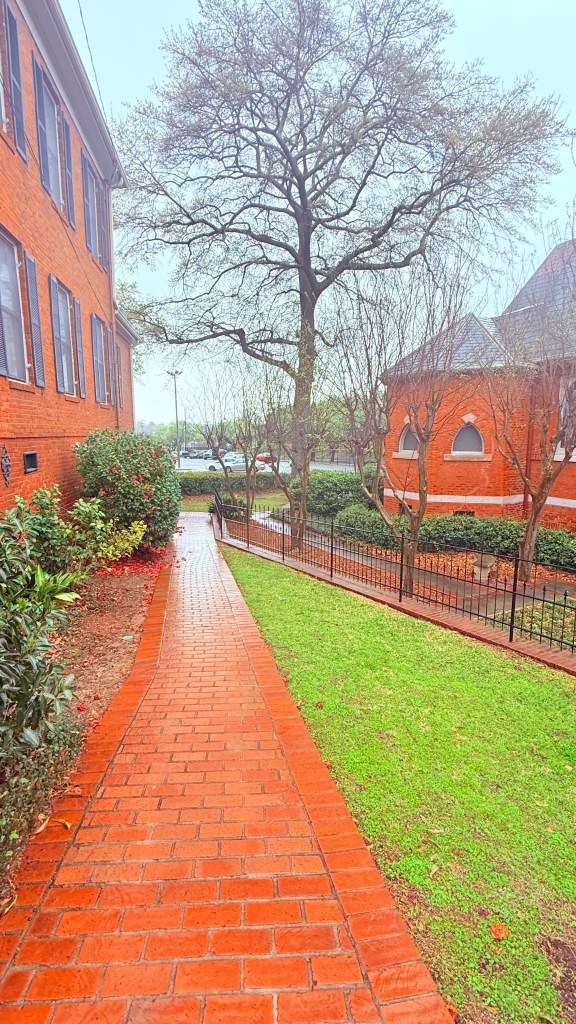
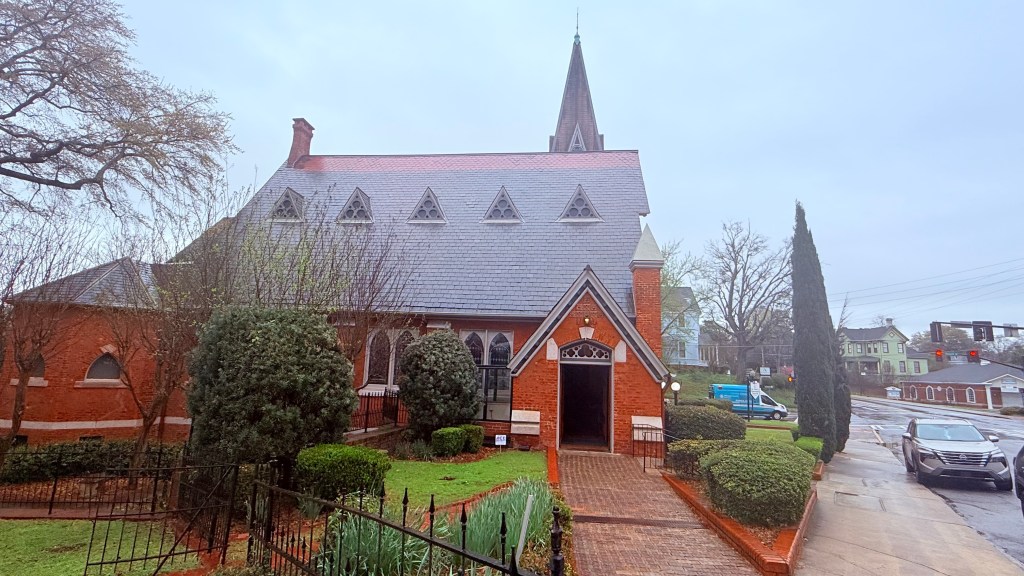
The church’s main entrance was slightly confusing at first, but we eventually figured it out. The wooden double doors displayed at the front of St. Paul’s showcase both a visual and a symbolic theme for visitors when they first approach the church. The doors give visitors a preview of what they are about to see visually within the church and give the visitors a small glimpse of how historic the congregation is.
Once inside, the atmosphere of the church is defined by the light that passes through the stained-glass windows. These windows are not just there for decor, and each window tells the story of a major historical event related to Christianity. The visual landscape of the interior of the church shifts just a bit within the months that I have visited. As the church shifts from Lent to Easter, the front stage of the church is decorated with a beautiful arrangement of flowers that are placed right below the cross. The arrival of Easter Sunday as it slowly approaches after Lent transforms the visual silence of Lent and is replaced with an abundance of flowers.
As we stepped through the double wooden doors, there were people engaging and talking to one another before everyone found a seat and settled down. As soon as everyone had taken a seat, the organ began to play. The beautiful sounds filled the walls and the high ceilings of the church. As the choir sang along with the organ, we noticed how different the sounds were from what we were expecting. We found the sound to be more dramatic, almost operatic singing. The sounds filled the church. Church members and those sitting joined in, further filling up the church with beautiful, harmonizing sounds of coming together.
Despite being such a historic congregation, a notable aspect of this congregation is its use of technology and social media to connect with both church members and a wider community. They have a YouTube channel, Facebook page, and website. Here, they post church updates, announcements, and memorial services. A unique aspect of their social media presence is their online devotional videos called “Compline.” These are 10-minute videos of church member Kathy Green having a conversational-style worship service. These are uploaded onto their Facebook page.
This use of technology allows the congregation to remain accessible beyond physical services, particularly for older members or those unable to attend in person. It also reflects an effort to stay relevant in a digitally connected society.
The strength of St. Paul’s community was made clear to us through the members’ welcoming aura. During our first visit, we were confused about the church’s overall procedure. I was not sure how I should conduct myself and often looked at my surroundings for guidance. A long-time churchgoer noticed my new face and helped me out. She helped me through the church’s communion segment, gave me the hymnal when it was time, and opened the page for me in the other blue book.
Another key thing about St. Paul is how tight-knit their community is. The sense of familiarity these congregants carry with them rubs off on newcomers, allowing them to feel welcomed. The relationship the congregants have with one another is personal and intimate. These people have been through many ups and downs with one another. This gives people purpose in returning, besides any Episcopalian dedication to going to church. It gives them a reason to go to church to see one another. A story told to us by a long-time churchgoer captures the community here at St. Paul’s. During their parents’ funeral, many members of the church attended. These members’ parents were not traditionally a part of this church. Despite that, many members still showed up to give their support because they care for this member.
While St. Paul highlights various strengths, there are factors that challenge the church’s ability to grow and sustain a community. Like many Mainline congregations, St. Paul’s has a lack of youth in their congregation. The main demographic consists of older individuals and retirees. There are a few families that attend this church with children. As a result, there are no Sunday school classes or separate activities for these age groups. These challenges raise questions as to how the community thinks about its future.
Despite these challenges, as one exits the church and retraces their steps back down the stone path towards the parking lot, the visual beauty of St. Paul’s Episcopal Church remains with you. From the heavy wooden doors that have welcomed many generations, and the kindest people that you will ever meet to the vibrant stained glass that fills up the church, every detail of the church serves a purpose. St. Paul’s proves that a church is more than just an ancient structure made of brick or wood. It is a living and breathing sanctuary in which the beauty of its surroundings is matched with the beauty found within the church and amongst its people.
Sabah Afridi is a Freshman majoring in Sociology
Sophie Gatkouth is a Freshman majoring in Sociology

